Why You Always Test for Chimney Gas Leaks

Signs of long-term condensation on building exterior- Humidity Control Services Kansas City MO
Signs of long-term condensation on building exterior


Who would have thought that this unsightly chimney provided clues to the source of a hidden gas leak?

On a recent call to replace an aging gas boiler, the owners reported a persistent gas smell. The gas company had previously inspected the building and didn’t find a gas leak using their detectors.

Yet the smell continued.  The point is – if you smell gas, however subtle the smell– there is a gas leak.   Somewhere.  The challenge can indeed be where to find it.

Built in 1923, this building was serviced by an older gravity boiler that had evidence of back drafting.  It also had an exposed chimney, a tile roof, rotting windows, scant insulation and little or no air sealing.

Rusted Pipe- Air Duct HVAC Services- Kansas City MO
So the pipe started to rust …

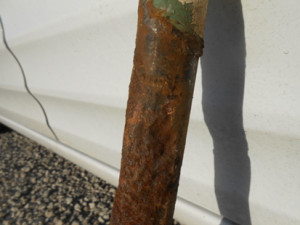
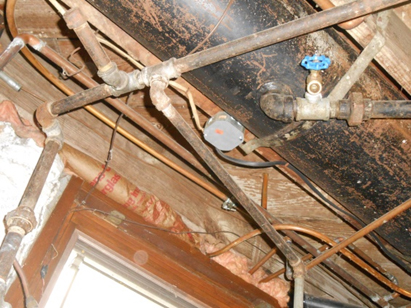
Why was the chimney in such bad shape? Each time the boiler cycled on and stayed on for a long period, the chimney dries out.  But during each short cycle of the boiler, the chimney stayed wet and dripped water.  For decades.  And those drips fell onto the basement rim joists and essentially provided a steady pool of stagnant water around 1-inch  steel gas pipe. So the pipe started to rust …. and leaks gas.

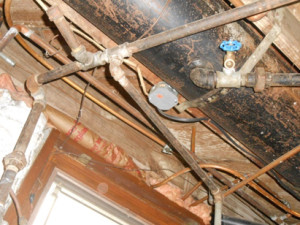
The company’s gas bills spiked last summer.  Workers thought sealing the rim joists would help cut down the bills.  Someone stuffed fiberglass insulation in the rim joists along the tight quarters of the old stone basement wall. This batt insulation also hid the horizontal gas pipe that connected the old boiler to  the outside meter.

Insulation Without Air Sealing- Insulation Services Kansas City MO
Insulation without air sealing doesn’t work.

However, stuffing fiberglass insulation doesn’t solve condensation problems. Water drips continued. They didn’t caulk properly in the rim joist cavity, nor shine a light on the gas pipe in the dark, dank space.  If they had, they would have noticed the rusty pipe and noticed the ongoing dampness.

After taking apart a portion of the sealed rim joists, I uncovered the rusty pipe.  My detector indicated over 20 pinpoints of gas leaks over a 24 inches of pipe.

If the workers could have had simply observed the condition of the pipe, and tested it with a simple gas detection tool prior to covering the rim joists, the problem would have been found immediately.  Rust isn’t good for anything, particularly pipes that carry combustion fuels.

I replaced the pipe; resealed the rim joists properly; and re-inspected every inch of the gas line and pipe.

Problem solved.

Insulation without air sealing doesn’t work.  Fiberglass insulation was jammed into the rim joist, but this practice doesn’t  solve condensation issues.  Fiberglass become a filter.

When rigid insulation is not installed on the exterior of a rim joist, it must be installed on the interior to control condensation on the rim joist.

Insulation without air sealing doesn’t work.  Fiberglass insulation was jammed into the rim joist, but this practice doesn’t  solve condensation issues.  Fiberglass becomes a filter.  When rigid insulation is not installed on the exterior of a rim joist, it must be installed on the interior to control condensation on the rim joist.   Eric Kjelshus

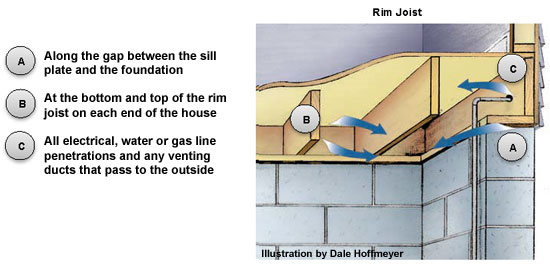
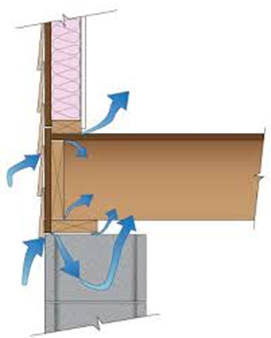
Below: best practices for proper sealing of rim joists:

Chimney Fundamentals: The Science of Venting Flue Gases – Part 1

Established in 1926, The Air Conditioning, Heating and Refrigeration NEWS is the HVACR contractor’s weekly newsmagazine and is the industry’s most trusted and utilized direct communications link to the HVACR buyer.

How to Keep Your Customers Safe as Well as Comfortable

By Eric Kjelshus

This multiple-part article series will discuss the basics, codes and standards, and the science behind chimneys. It will show how back drafting affects chimney performance, while explaining the principles of positive pressure. It will explain how to create and use positive pressure so chimneys will draft for safety and performance.

Read Editorial

(Part 2 will provide a discussion of venting categories.)

The Air Conditioning, Heating and Refrigeration NEWS Publication date: 10/20/2014

Do we need a Carbon Monoxide detector in our home?

Carbon Monoxide or CO is very dangerous. It can’t be seen or smelled and without a carbon monoxide detector.

Eric Kjelshus Energy Heating and Cooling installs and services the National Safety Institute’s Low Level Carbon Monoxide Monitor to help our customers combat the silent killer – CO.

Consider these facts about Carbon Monoxide:

  • Carbon Monoxide (CO) is the number one cause of accidental poisoning deaths in the United States, according to the Consumer Products Safety Commission. It’s estimated approximately 500 deaths occur each year from accidental CO poisoning. Carbon Monoxide also results in approximately 10,000 illnesses each year, for which people are treated in hospital emergency rooms, a number which is underestimated.
  • Carbon Monoxide is totally undetectable by human senses; it is an odorless, colorless and tasteless poison and is so deadly that it has earned the name, “The Silent Killer.” Carbon Monoxide is highly toxic and can act on the body quickly in high concentrations, or slowly over long periods of time.

Household appliances can be a deadly source of CO poison

Even with regular maintenance and checkups, any appliance can malfunction at any time, silently emitting poisonous CO into your air with no warning. CO is a by-product of incomplete combustion of fuels like natural gas, liquid propane, coal, oil and wood.

This means a defective furnace, a blocked chimney, faulty gas appliances like a water heater or range, clogged venting or a car idling in the garage can all present a serious danger to your family. Unless, of course, you help guard your family against this threat by having at least one dependable CO detector in your home.

No appliance is designed to last forever. The potential for exposure to CO is a real one, and your family could be poisoned without even knowing it. Installing a CO detector is one important way to alert your family to this potential danger.

Symptoms of CO Poisoning

At low level concentrations, CO can go undetected and contribute to nagging illnesses. Symptoms such as headaches and fatigue are common to illnesses such as the flu or the common cold. Things like “memory loss” and “facial ticks” are also symptoms of “Low Level” CO poisoning.

Home Centers and Hardware stores sell CO Alarms but they may be inadequate

Consumers Reports states the biggest problem with CO Alarms is “False Alarms” and “No Alarm” situations. Imagine your house is filling up with toxic CO levels an your CO Alarm is hanging silently on the wall. Yikes! That’s why we strongly suggest you buy what the pro’s sell. A CO Monitor with both low and high level alarms.

Saving a few bucks can have draw-backs. But here are the facts… most alarms sold in a Home Center or Hardware Store only provide “High Level Protection.” Good but not good enough for you family’s complete protection.

In addition, most CO alarms sold in Home Centers and Hardware stores have a 2 year life-span (as often stated in the fine print). Compare that to the industry standard “electrochemical sensor” with a full 5 years life span…guaranteed.

That is why Eric Kjelshus Energy Heating and Cooling installs and services the National Safety Institute’s Low Level Carbon Monoxide Monitor.

What to do if you’re CO Monitor goes off

Get out of the house! Don’t open windows…. Don’t check your alarm…. Call your service provider from a neighbors home to perform a CO Investigation. Skilled technicians are great but what you want in an alarm situation is a Technician trained in “Combustion Efficiency” and “Carbon Monoxide Detection.”

You may also call the Fire Department or Utility Company if your alarm goes off. The fire department will respond to a CO alarm. It’s their job as first responders to check your blood for dangerous levels of CO. They will also evacuate you from the premises if a serious CO condition exists. However, fixing the problem is not their job, you must call a heating contractor.

Utility companies also by law have to respond to a CO call but it’s not free. When they arrive their technician will determine if the conditions in the house are safe or not…however, many times they fail to determine the exact cause and shut off your gas supply if a dangerous condition exists. Even if they stumble into the source of CO they still will shut down the suspected appliance. They will generally advise you to call a contractor.

Eric Kjelshus Energy Heating and Cooling has been providing air conditioning services in the Kansas City area since 1972. Our commitment to quality and dedication to excellence in customer care has made Eric Kjelshus Energy Heating and Cooling the #1 heating and cooling services company in the Kansas City Metro Area.

What Are We Breathing?

Air pollution is a common contributor to lung disease. Diseases such as asthma, respiratory tract infections and lung cancer claim over a quarter of a million lives every year. While some forms of air pollution are uncontrollable. The indoor air quality of your home or office is something that can be controlled. Poor indoor air quality can cause serious chronic respiratory diseases in some cases, however, more common problems are often chronic sinusitis, headaches, dry eyes, nasal congestion, nausea and fatigue. In addition, those already with respiratory problems are placed at even greater risk. There are a number of different sources of indoor air pollution, some more harmful than others, but all can be controlled to a certain extent.

BIOLOGICAL POLLUTANTS

Biological contributors to poor air quality include toxic mold, bacteria, mildew, viruses, animal dander, dust mites and pollen. These pollutants can originate from a variety of sources. Pollen produced by plants; viruses and bacteria can be carried and transmitted by people, animals, soil and plant debris; and any household pets are a source of dander. Any sort of ventilation system, whether it be heating or cooling, can be a breeding ground for biological pollutants if air ducts and air filters are not cleaned properly; effectively spreading them through your home or office.

RADON

Some sources of poor indoor air quality may remain hidden until tested. Radon is a naturally occurring radioactive gas most commonly produced from uranium decay in soil and rock. Radon is colorless and odorless gas that can leak into homes through dirt floors, exposed rock, cracks in the foundation floor and walls, drains, wells and any other opening to subterranean soil. Radon is estimated to be the second leading cause of lung cancer and approximately 1 out of 15 homes in the United States have radon levels above the EPA’s recommended action level.

ENVIRONMENTAL TOBACCO SMOKE (ETS)

Environmental tobacco smoke, also known as “second hand smoke” or “passive smoking”, is a combination of smoke directly from the end of a cigarette and the smoke exhaled by the smoker. ETS is known to contain over 4,000 chemicals, 200 of which are poisonous and approximately 40 which are carcinogenic. ETS is one of the few causes of poor indoor air quality that is completely preventable.

FORMALDEHYDE

Formaldehyde is a chemical used widely in the building construction industry. In homes and offices, the most common source is formaldehyde-based adhesives used in carpets, upholstery, particleboard, plywood, and fiberboard. It is a colorless yet pungent-smelling gas that can cause eye, nose and throat irritation as well as headaches, dizziness and nausea.

ASBESTOS

Asbestos is a mineral fiber commonly used in older building construction materials. It was used mainly for its durability as an insulator and fire-retardant. Asbestos is most commonly found in older homes in furnace insulating materials, shingles, pipe insulation, and floor/ceiling tiles. Asbestos is dangerous when microscopic particles become suspended in air. Asbestos particles become airborne when asbestos-containing materials are disturbed through remodeling activities such as sanding and cutting. Improperly removing such materials also leads to increased airborne concentrations. High concentrations of airborne asbestos particles can cause serious health risks such as lung cancer, mesothelioma, and asbestosis. Symptoms of these diseases do not become apparent until years after initial exposure.

CARBON MONOXIDE/NITROGEN DIOXIDE

Home appliances and heating systems that use natural gas, fuel or wood can all contribute to poor indoor air quality. Any type of combustion appliance that is misused, improperly installed and maintained, or inadequately ventilated can cause high levels of exhaust byproducts including Carbon Monoxide (CO) and Nitrogen Dioxide (NO2). Carbon Monoxide is a colorless and odorless gas that interferes with the body’s oxygen delivery systems. High concentrations can cause unconsciousness and even death, while low concentrations lead to headaches, nausea, disorientation and fatigue. Nitrogen Dioxide is a colorless and odorless gas that can cause irritation to mucus membranes such as eyes, nose and throat. High exposure can lead to shortness of breath and prolonged exposure can lead to damaged respiratory tissue as well as chronic bronchitis.

HOUSEHOLD CHEMICAL PRODUCTS

There are many household products that can lead to poor indoor air quality. Cleaning products, personal care products, pesticides, paints and solvents all contain chemicals that can lead to allergic reactions and irritations if not used properly.

About Eric Kjelshus Energy Heating and Cooling

Eric Kjelshus Energy Heating and Cooling has been providing air conditioning services in the Kansas City area since 1972. Our commitment to quality and dedication to excellence in customer care has made Eric Kjelshus Energy Heating and Cooling the #1 heating and cooling services company in the Kansas City Metro Area.
Humidifier Health & Safety

Dry winter air, especially when combined with home heating, can contribute to uncomfortable dryness and irritation of the nose, throat, lips, and skin, as well as household nuisances such as peeling wallpaper, static electricity and cracking paint and wooden furniture. A simple and inexpensive remedy is to use a humidifier, which releases mist into the air, raising the humidity in the room.

Humidifiers come with their problems, however, because excess moisture can encourage the growth of biological organisms in the home, including dust mites and mold, both of which are implicated in allergies and other respiratory problems related to poor indoor air quality. Recent EPA studies suggest that ultrasonic and impeller humidifiers, also known as “cool mist” humidifiers, can disperse both microorganisms and mineral pollutants into the air. Breathing these pollutants has been linked to a malady called “humidifier fever,” an inflammation of the lungs and breathing passages.

Young children, the elderly, and those who have respiratory problems or lung diseases are particularly susceptible to certain types of airborne pollutants, including the minerals, bacteria, and molds released from household humidifiers. But by following a few simple tips, you can greatly reduce the potential problems caused by your humidifier.

HUMIDIFIER TYPES AND POTENTIAL POLLUTANTS
Home humidifiers may be a central unit built into the central HVAC system, smaller console-mounted units designed for floor use, or smaller portable units, but they all generally fall into a few basic types:

Ultrasonic – creates a cool mist by means of ultrasonic sound vibrations.
Impeller– also called “cool mist,” which produce a mist by means of a high speed rotating disk
Evaporative– transmits moisture into the air invisibly by using a fan to blow air through a moistened absorbent material, such as a belt, wick, or filter
Steam vaporizer– creates steam by heating water with an electrical heating element or electrodes. “Warm mist” humidifiers are a type of steam vaporizer humidifier in which the steam is cooled before exiting the machine.

Typically speaking, studies have shown that Ultrasonic or Impeller humidifiers are among the worst offenders when it comes to mold and mineral dust pollution. But while evaporative and “warm mist” humidifiers have not been shown to release significant amounts of molds or bacteria into the air, be aware that mold can grow in any humidifier which uses a tank of standing water. Excessively humid conditions may also contribute to condensation on walls and other surfaces, which also encourages mold to grow.

The first tips of humidifier use in the home is to only use a humidifier when you need it: most recommend keeping the indoor humidity at or below 50-55%. You should also position your humidifier at least a few feet away from walls and furniture, if possible.

Eric Kjelshus Energy Heating and Cooling has been providing air conditioning services in the Kansas City area since 1972. Our commitment to quality and dedication to excellence in customer care has made Eric Kjelshus Energy Heating and Cooling the #1 heating and cooling services company in the Kansas City Metro Area.
12 Steps to Improving Your Indoor Air Quality

1. Test your Indoor Air Quality

If your family is sensitive to mold, you may conduct tests for mold only; or you can do a comprehensive test with a complete breakdown of your air makeup, helping you decide where problem areas lie. These tests are relatively inexpensive and readily available, and are a great starting point for improving the air quality in your home, giving you an idea of which areas to tackle first. After employing these 12 strategies, test the indoor air quality again to confirm whether or not you have removed dangerous elements from your breathing air.

2. Make your home smoke-free

Environmental Tobacco Smoke (ETS), often known as “second hand smoke,” is very harmful and can lead to serious health problems such as chronic sinusitis and lung cancer in adults and lower respiratory tract infections in children. Taking smoking outside reduces concentrations of toxic chemicals and carcinogens found in ETS and is an important factor in improving indoor air quality in the home or office.

3. Improving ventilation improves indoor air quality

Ventilation is easily improved by leaving doors between rooms open as well as opening windows whenever possible. Exhaust fans should be used in bathrooms, kitchens, and laundry rooms to vent moisture and chemicals directed outdoors. Quiet, energy-efficient fans can be used for these applications.

4. Control household humidity levels

Keeping low humidity levels is important in controlling the growth of toxic mold and other biological contaminants. This can be done by eliminating water leaks and sources of standing water. Also use your air conditioner, and install dehumidifiers in problem areas such as basements. Keep the dehumidifier clean and free from mold, as they can become sources of pollution if contaminated. If you live in a high humidity part of the country, home mold testing is recommended to ensure clean air.

5. Have your HVAC system cleaned

Much more important than cleaning your duct work is having your HVAC system cleaned. Your A/C drip pan could be holding water and growing mold which will then be blown directly into your air ducts and out through the vents. The blowers for your HVAC may not have been cleaned in years, and could have built up dirt and dust and could also be harboring dust mites and toxic molds. Lastly, the condenser coils may have rust and corrosion buildup, which is not only harmful to air quality, but also decreases your HVAC system’s efficiency, increasing energy costs. A thorough furnace and A/C system cleaning varies greatly in price from company to company, but this can improve your HVAC system’s cooling and heating efficiency and save you money in the long run. Supervise the work to make sure all critical components of the HVAC system are cleaned — once they are placed back in the system, they are out of sight.

6. Prevent Carbon Monoxide poisoning

Any fuel-burning household appliance (gas stoves, hot water heaters, clothes dryers, etc.) can potentially release harmful chemicals as by-products of combustion. All such appliances should be inspected by a qualified technician once a year. You should also monitor the indoor air quality of your home by installing Carbon Monoxide detectors, especially near bedrooms.

7. Clean and Vacuum Regularly

Airborne dust particles, microscopic insect droppings, and mold spores cause allergic reactions and asthma outbreaks. Cleaning regularly can help control indoor air quality. Vacuum rugs and carpets at least once a week. Consider a vacuum equipped with an allergen reducer or HEPA filter, which prevents reintroducing allergens and fine particles back into the air. Wipe down or dust any hard surfaces regularly, and clean up mold near sinks, water pipes, or bathtubs immediately to prevent releasing allergenic or toxic spores into the air.

8. Control Dust Mites

To combat the growth of dust mites, a common cause of indoor allergy symptoms, bedding should always be washed in hot water (at least 130° F). You might consider using allergen-free cases on your mattresses and pillows. Your children’s blankets and stuffed toys can harbor dust mites as well; wash them regularly in hot water to keep your children safe from allergies and asthma triggers.

9. Put a High Efficiency Particulate Air (HEPA) filter in your air handling system

Using a HEPA Filter with help keep particles out of the air and off of the ductwork of your heating and cooling systems. Filters should be replaced with regularity, every 1-2 months depending on how much the system is running. Proper use and maintenance will help improve indoor air quality and increase time between necessary Air Duct Cleanings.

10. Exhaust Gas Appliances

Make sure gas stoves are fitted with a hood fan that exhausts directly outside. Using a hood fan and/or an open window while cooking will help improve indoor air quality, and prevent Carbon Monoxide contamination.

11. Be aware of toxic chemicals found in household cleaning products and pesticides

Household cleaning products & pesticides should be used only according to manufacturers’ directions. Keep your house well ventilated while using. In order to help preserve your home’s indoor air quality, store harmful chemicals and volatile compounds (paints, solvents, cleaners and pesticides) away from occupied spaces and air ventilation intakes. If you have aggravated sensitivity to certain chemicals, consider a home air cleaner with gas-phase filtration to keep chemical concentrations from reaching irritating levels.

12. Purchase a home air purifier

Running an air purifier in your home will help keep indoor pollutants at low levels. Used in conjunction with the HEPA filter you’ve added to your heating and cooling system (Step 9), a home air cleaner using HEPA filter technology, ionic air purification, activated carbon, or a hybrid of these technologies can keep the air in your home clean and healthy.

Eric Kjelshus Energy Heating and Cooling has been providing air conditioning services in the Kansas City area since 1972. Our commitment to quality and dedication to excellence in customer care has made Eric Kjelshus Energy Heating and Cooling the #1 heating and cooling services company in the Kansas City Metro Area.
How often should I change the Air Filter?

If you have a fiberglass throwaway filter, you should change it every 30 days. The filter helps keep your duct system, motors, and coils cleaner longer.

Here’s a great tip for remembering to change the filter:  When you get your monthly electric bill… change the air filter. If you do not change your filter, your electric bill may increase.

The same is true if you own an electrostatic or electronic air cleaner. They should be washed every 30 days to remain efficient.

Eric Kjelshus Energy Heating and Cooling has been providing air conditioning services in the Kansas City area since 1972. Our commitment to quality and dedication to excellence in customer care has made Eric Kjelshus Energy Heating and Cooling the #1 heating and cooling services company in the Kansas City Metro Area.